July 2026 cover story: AI in Pharma, Pharmaceutical Ingredients Review, with the ANCOVE framework
Pharmaceutical Ingredients Review · AI in Pharma, July 2026 cover story
Featured in Pharmaceutical Ingredients Review (Pharma India Magazine)
Within pharmaceutical environments, success should not be measured by how accurately an AI system detects a failure after it occurs. Instead, success should be measured by whether the failure occurs at all.
Cover story panellist
Our AI in Pharma panel is the July 2026 cover story of Pharmaceutical Ingredients Review. I spoke on agentic AI, moving from prediction to prevention, and Atlas AI Labs' ANCOVE framework for trustworthy pharma supply chains.
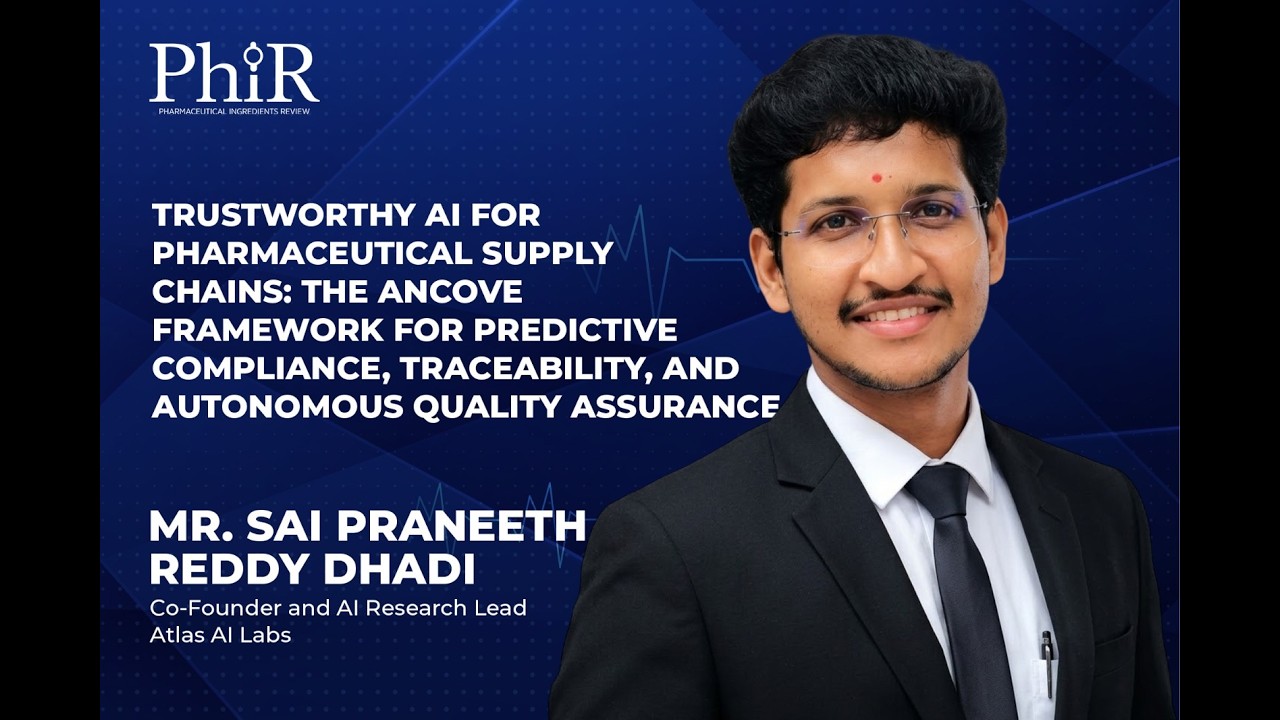
Our panel discussion on AI in Pharma is the July 2026 cover story of Pharmaceutical Ingredients Review (Pharma India Magazine), published on 2 July 2026.
The panel was moderated by Dr Rajashri Mokashi (Director, GCV Life Pvt. Ltd, and Founder, Gregor Analytics), with Dr Preeti Nigam Joshi (FastSense Innovations), Dr Akash Nag (Pharmaguard AI), Ms Naveli Sharma (Nishith Desai Associates) and me, representing Atlas AI Labs as Co-Founder and AI Research Lead.
What I spoke about
- Three waves of AI: prediction first, then assistance, and now agentic systems that reason across several steps, coordinate actions and support decisions with little supervision. The open question is not whether they will be adopted, but where human oversight must stay mandatory.
- From prediction to prevention: a trustworthy autonomous system keeps validating operating conditions and flags emerging risks before compliance issues, quality deviations or failures happen. AI recommends; humans keep the final decision.
- The ANCOVE framework: our approach to trustworthy AI for pharmaceutical supply chains, covering predictive compliance, traceability and autonomous quality assurance.
- Near-term opportunities: medical imaging, provided India first builds datasets that reflect Indian patient populations.
True transformation in high-stakes industries does not come from naive automation. It needs execution-grounded, verifiable architecture that respects real-world constraints.
Watch the ANCOVE talk and the full panel discussion, or read the cover story.